Monday, 19 May 2014

When thinking about stock options, what do you consider? - Part One

By
       Wambui Mukundi and Rakeli Gichuki

The reasons for the rise and fall of share value of listed companies are complex. Stock prices are affected by a myriad of direct and indirect reasons depending on the industry and company in question.  Whereas these factors cannot be traced in the financial statements, there effect is always reflected in the books. Companies in contemplation of these factors often conduct a PESTEL analysis to determine how such factors can be mitigated or used in their favour. Individuals intending to invest in the stock markets should also conduct the necessary research on external events affecting or likely to affect particular industry or listed company. Some of the identified external factors include:

National, Regional and International Events
Political events such local and regional wars cause political instability and hinder investor confidence in the stock market thus affecting the performance of specific stocks. For instance, listed companies within the tourism industry suffer loss of revenue due to low sales during an era of political instability. A study conducted to show market performance during the general period indicated that performance of the markets is strongly linked to political events and regime prevailing. The study showed a steady decline of the market performance from 1997 to 2002 during the last five years of the KANU Regime. The market thereafter improved steadily after the transition to the coalition government in 2003. During the 2007, Post election violence there was a considerable decrease in the market performance. The Reuter’s consumer and retail news also reported that TPS Serena had to deal with a slump in Kenya’s tourism market in the first half of 2013 in anticipation of election violence following the events that transpired in 2007.

Sentiments
Investors rely not only on expert opinion but also on how the public reacts to certain information relating to a listed company. This hype maybe about the release of a new product into the market or a merger amongst others reasons. It does not necessarily have to be based on truth but investors are known to nonetheless base their investment decision on the same. A classic Kenyan case would be the Initial Public Offering of the +Safaricom shares. Members of the public heavily relied on the hype to purchase their shares with the company. The shares significantly oversubscribed and demystified the myth that only the wealthy can invest in the stock market. Whether the public was right in purchasing these stocks only the future can tell and I am particularly optimistic. Sometimes the masses are right and the stock is worth the hype however for obvious reasons this is not always the right way to go about investing. Besides, a lot of hype has been created around pyramid schemes that have eventually collapsed.

Development
Developments surrounding certain Industries also have effect on the price of certain securities. Such developments may be social, legal or economic. For instance listed companies embracing technology and moving along with the digital migration are likely to attract more investors as opposed counterparts who do not. +Safaricom also takes lead on this. This is because it shows that the company is striving for efficiency, which results to increased profits.

Inflation
Other external influences include Inflation rates. Investors opt to go for government bonds to take advantage of the high interests as well as ensure protection of their investments. Foreign currency rates also affect the stock market especially foreign companies listed in Kenya and the reverse.

Conclusion
It is the duty of an investor to conduct relevant research with external factors in mind before leaving it to chance. A good method of doing this would be to conduct PESTEL analysis of their preferred stock to determine the factors not foreseeable by merely reading the financial reports of the company. While the above factors may affect the price of a security, it should however be noted that not all developments surrounding a particular industry or company is reflected on the price of the particular security. The effect of both external and internal factors on the price is dependent on how shareholders and potential investors react to the information of the presence of such factors. Some investors react immediately, others observe in order to note the difference in the value of security in question. Others access the information after the effect.   

--------------------------------------------------------------------

References
Agela Kithinji& Wilson Ngugi . Stock Market performance before and after general elections-Acase study of the Nairobi Stock Exchange. Retrieved from http://www.aibuma.org/archive/proceedings/downloads/Angela%20Kithinji,%20Kenya.pdf

Monday, 12 May 2014

The Stock Market

By
      Rakeli Gichuki and Wambui Mukundi


The Stock Market
Well, a lot is said about the stock market, and to most, there is little to no difference between investing in the stock market and gambling. Admittedly there are certain aspects of gambling that may be deemed similar to trading on the stock market. For starters both are fundamentally randomly determined and unpredictable at least on the face of it. It has as well been argued that trading in the stock market like gambling merely involves capital transfer without creation of wealth especially when done for shorter gains. Of course the obvious counter argument is that when you purchase stock in listed company you buy a stake in the company and therefore creating wealth. However, it is important to note that knowledge of how the complex market works is what draws the line between investing in stock options and gambling. Whereas the latter, depends on sheer luck and a balance of probabilities, the former depends on accuracy of research done by individual or accuracy of advice given. Gambling is a single game played within a set of rules and hardly influenced by external events. The price of various stocks on the other hand is highly influenced by external events related to the industry or the listed company. A trader is therefore expected to keep abreast with such external factors before making his trade. This aspect of research renders a greater chance of success in the stock market than a player in gambling.

The presence of loss mitigation strategies available for the trader is also another key difference between the two. Investors in the stock market have a variety of ways to prevent loss of the risked amount. This advantage is not available to gamblers. While a trader can prevent further loss by selling shares of a company whose stocks prices are dropping, a gambler cannot retrieve his chip(s) once they are on the table if he senses defeat.

The concept of time is another key difference. Once a game or whatever activity associated with the gamble is over then the opportunity to gain ends with it. Investing in the stock market is a perpetual and therefore time rewarding. Investors have the advantage of receiving dividends for their risked money and the possibility of increase in the value of their stock over time. The law requires that information related to the stock market is availed to the general public.  Further it criminalizes unfair use of information by those having access to inside information at the expense of the public. This ensures that the shareholders or prospective traders are making informed decision based on the available information. This advantage is not available in the world of gamblers.

 In addition to the above, the stock market, specifically investing in share options involves acquiring a stake in a particular company. It is a means through which, an investor is entitled to the assets, and a fraction of profits and in unfortunate circumstances losses of a company, yet in gambling there is no creation of value.


However, in my opinion, it is misleading to use absolute statements when it comes to analyzing differences between the stock market investing and gambling. In both, there is an obvious degree of speculation on the risk of a certain venture as well as a considerable amount of skill required to improve chances of success. The difference then is, as stated earlier, the fact that gambling is a zero-sum game.

People go into the stock market or gambling for the sole purpose of achieving economic gain. Whereas, one option gives higher levels of success, resulting from intelligent guessing because of research done and information gathered; the other option is contrived to entice and entertain and not necessarily to create profits, or wealth.


Therefore, to succeed in the stock market, academic effort has to go into it. First, one should understand the various jargon's ordinary in the everyday dealings in the stock market. Moreover, for young people not able to afford the option of hiring an advisor, consider carrying out research on market analysis in groups of persons with similar interest.

There are opportunities engineered to give young people a chance to learn about the stock market. One is the young investors challenge in which my friend WambuiMukundi and I participate in. Alternatively, there are a number of low risk and capital investment options, which young people can pursue. One is the investment income approach where one invests in companies that offer dividends. The Collective Investment Schemes such as the Unit Trust and Mutual Funds offer interesting options for low-risk investing. 


--------------------------------------------------


References

Joha Sparks, Fellows with black hurts. Retrieved from:

http://www.fee.org/the_freeman/detail/those-fellows-with-black-hats-the-speculators


Michael gutmann, Are trading and gambling the same. Retrieved from http://m.futuresmag.com/2013/12/16/are-trading-and-gambling-the-same?t=editors-choice


Stephan Abraham, Going All-In: Comparing investing and gambling. Retrieved from http://www.investopedia.com/articles/basics/09/compare-investing-gambling.asp


Monday, 17 February 2014

Lessons from Death and the Thought of Dying

By Rakeli Gichuki

On Death
It is not easy to conceive our own mortality. In the back of your mind, you are the starring of your life’s movie and the starring will walk through fire, dodge bullets, survive a bomb attack, get shot at, and they do not die. I started thinking about my inevitable death after I lost my father because it occurred to that our reunion could only be through my dying. It was as if, by embracing the idea of death we are somehow (him and me) in it together. By going through the stages of grief and by reflecting on the inevitability of my own death, I learn to live more responsibly.

The stages of grief..
       Feigning Strength
Never in my life have I been confronted with such a hard reality as that of accepting the demise of my old man. So many aphorisms are told to console bereaved families; “He is just asleep,” Death ends a life and not a relationship.” The aphorisms are as true as they are false. Death is no ordinary sleep, and as time goes by, you realize that you don’t get to have a relationship with someone’s memory regardless of how much you love him or her. You only get to recall certain fragments of time, lived in the past. That is all you get, not a relationship. The hand of death takes the relationship.
So, you are urged to be strong, which almost impossible. When you loose someone you love, it breaks you from the inside out. The tears that flow from your eyes, the numbness in your heart, and the weakness in your knees, are shadows of the pain within you.  Yet, it is important to forge some semblance of strength. It is important to get out of bed, and try to live your life despite the funk. Do not be in a hurry to get over it or fathom the consequences of his or her death. Take it a day at a time because life goes on with so much audacity it hurts. Throw yourself into the mix of your responsibilities and the relationships you value the most, as it slowly and painfully dawns on you, the person is no more.
    
      The Firsts
After a month of being in constant shock, you move to the next stage, the firsts. You take note of the first time you take a certain action after death took your loved. First time you spent an hour without thinking about him or her, your first birthday, their first birthday, first Christmas and so on. You automatically count the firsts, from important life events to the very trivial occurrences. It hurts as you begin to notice how necessary it is to move on with life.
     
      The Blur
Loss is very confusing. The confusion is constant in all the grief stages but after a while, there are episodes of understanding, and you become stronger. It is now perhaps six months after the death of the person, and you are more or less able to comprehend it. Most of the times you’re strong, even with the episodes of anguish when grief overwhelms you without warning. You still religiously count the first, as if to record the forms in which life is moving on. It starts to feel like you’re living him or her behind. Like they stuck their foot in some point in time and can no longer walk with you into the present.  
At this stage, you understand that time may not heal you as it had promised; it will only teach you how to manage, despite the pain. The pain, the pain reveals to you certain truths about life and yourself that make you a better person. It is not just a pure tragedy; it has some beauty to it.

On Dying
Someday you are going die. It may be soon. It will be sudden. It will leave those who love you with a broken heart. Most likely, death will take you by surprise. On the other hand, you may live to a certain point of your life, and the doctors will tell you that you have a terminal disease. You may become anxious. You may deny the reality of your impending death and then die without accepting. These scenarios are not exhaustive.  It could play out in a number of ways since death is unpredictable.
He is also indifferent and aloof. It does not matter whether your family loves you or not. It does not matter whether you have finished all the plans you had in mind. It does not matter whether you are a kind person or a basic jerk, a success or a failure; he gives no regard to the colour of your skin or social status. He takes, and he takes indiscriminately.

“There's a better approach. To know you're going to die, and to be prepared for it at any time. That's better. That way, you can actually be more involved in your life while you're living it.” 


Death is inevitable. It will happen to all of us. We need to live with the end in mind, in order to improve the quality of the life we live. It is important that we talk to our children about death. Possibly, around that time when we tell them about puberty and changes to expect in their bodies, or whenever as a parent you get the courage to do so. Let them know they need to be responsible for their actions because our actions become the substance of the legacy we leave. Talk to your spouse, your sister, your mother and everybody you love. Talk about death. Talk about your dying. Imagine the morning after your death. Try to imagine what will be their fondest memory of you on the first anniversary after your death.
As you embrace your mortality, it will give you the courage to go after your dreams, to stay true to your values and to live by your ideals.
Wear your heart on your sleeve; this just could be your last day.


Article first published on Thought Catalog.


Saturday, 14 December 2013

Global Citizens Festival Messages from the Global Citizen Course Participants

By Rakeli Gichuki

In bids to promote global citizenship in the world, the following are some of the principles we felt that would foster global citizenship.
Abdul-Hanan from Ghana

Anthony from Kenya

Asaph from Tanzania

Christina from Denmark

Christine from Denmark

Dorcas from Zimbambwe

Esben from Denmark

Evans from Kenya

Fatma from Kenya

Flora from Zimbambwe

Johanne from Denmark

Johanne from Denmark

Laurits from Denmark

Lise from Denmark

Mette Marrie

Nicholas from Ghana

Pamela Rose from Kenya

Rachael from Kenya

Sam from Kenya

Sille from Denmark

Stine from Denmark

Tobias from Denmark

Yusuph from Tanzania

Friday, 13 December 2013

Making of The Global Citizens Festival

By Rakeli Gichuki

ActionAid’s Global Platform Nanyuki is currently abuzz with activity, the task in hand being preparations for the global citizens festival to take place in Nanyuki town right outside Nakumatt Supermarket. The idea of having a festival came about from previous global citizen course participants and current facilitators. The previous global citizens course participant thought that it would be important to have an activity that is captures the underlying philosophy of the course, while the facilitators thought would be important to celebrate global citizenship with a festival. Thus, the festival embodies ideals from both parties since it is a celebration of global citizenship. Furthermore, festival presented an ideal way for the global Platform Nanyuki to have its presence felt in Nanyuki town. 
Moreover, Nanyuki is a town that hosts foreigners from different parts of the world, from British, Italians, American et cetera, all with different agendas. The festival then is an ideal way of raising the consciousness of the people of Nanyuki on global citizenship a fact they live with every day. In addition to the above, the festival is also a way of appreciating the people of Nanyuki for being host not only to the global platform Nanyuki and but also to the myriad of foreigners living in the town.
The preparations for the festival entailed a number of things. The first step was a brainstorming session started three weeks ago in Dar-es-Salaam using the concept of Future Workshop. Secondly, when in Kenya, the participants had to figure out what the theme of the festival would be, and this was easy seeing that our predecessors had thought about it, we agreed unanimously to have the theme of the festival be a celebration of global citizenship. Thirdly, we had to come up with the message that we would want to share with the world. Since we are a diverse group from different parts of the world, we all had different messages that matched with the theme. We therefore decided that we would all want a chance to share our individual messages. Christine’s, a facilitator in the GCC, 
Christine holding up her message
message is Solidarity. For her, solidarity is all about building relevant alliances that foster the movement of social change.
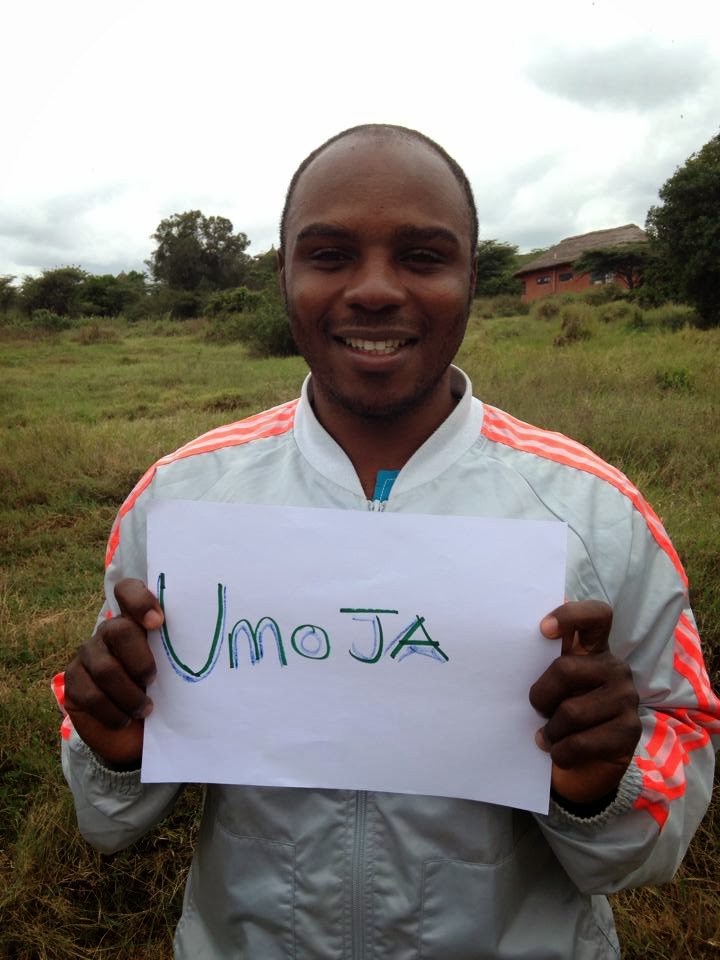
Abdul-Hanan
Abdul-Hanan holding up his message
 a global citizen course participant, message is Umoja. Umoja is a Swahili word that means unity and for him Unity across geographical borders is essential if the notion of global citizenship is to thrive.
Next, we had to come up with various country presentations for our various countries to present during the festival. For the Kenyan’s the presentation is about our independence. It features the union jack flag giving way for to the Kenyan flag after we won independence. The Ghanaian’s participants presented a historical timeline of the major events leading up to independence. 
The Danes presentation featured prominent persons in their country as well as interesting facts they thought people should know. The Zimbabwean also gave a brief historical background of their country as well as popular tourist attraction sites. The Tanzanians talked about two most important natural features of their country, which is the Ngorongoro Crater and Mt. Kilimanjaro.  
A lot of effort went into ensuring that the festival come to life. It took us roughly three days to put everything together and by Friday evening, everything was in place, simply waiting for the big day. 

Saturday, 23 November 2013

Save and Savour the World

By Rakeli Gichuki


One of my favourite authors E.B White author of the book Charlotte’s Web had this to say about life and the world; “If the world were merely seductive, that would be easy. If it were merely challenging, that would be no problem. But I arise in the morning torn between a desire to improve the world and a desire to enjoy the world. This makes it hard to plan the day.”  Well, fortunately for the world there are those who are able to achieve the delicate balance between savouring the world and doing good for the world.
This fine balance is impressively achieved through a social enterprise known as Wonder Workshop where basically art is used to savour the beauty of the great country of Tanzania and at the same time, act as a source of livelihood for people who would otherwise languish in poverty and despair.
Wonder Workshop is an organization based in Tanzania that creates art items through recycling various materials ranging from paper, glass and metal. It provides employment for over 40 people majority of whom are people living with a physical disability


Wonder workshop shop
Friday the 15th of November 2013 saw the GCC participants visit the wonder workshop in Dar es Salaam, Tanzania. In the workshop, we were taken the process of producing some of the products the organization puts up for sale. The workshop is in three parts depending on the materials used in production. There is the metal and wood section that produces metallic or wood art items using metal or wood. Most of the materials in this section depict some of the beautiful animals Tanzania has within its borders. The artist make the animals either in small sizes that can be used as play toys for children or for home deco while others are made into life size metallic cut outs of the animals for a variety of use. 
Then we have the glass section where either the glass makes certain items such as flower vases or toothbrush holders. The artists crush and mold the glass into different shapes to make different kinds of ornaments. The paper section recycles paper to make cards, bookmarks and calendars among other things. 
In the workshop we met Rukia a married mother of two. Rukia has been working in the workshop for the past seven years in the final stage of the paper section where she puts together various pieces of paper to make calendars, greeting cards, et cetera. She is quite happy because, were it not for the workshop she would begging for money in the streets. Even though the revenue generated from her work is not able to fulfill all of her financial needs, Rukia is happy because she is able to provide for her two children as well as support her husband, who is currently unemployed.
Rukia showing a card she made

We also had the chance to talk to Rose in the glass section. She is a very vibrant woman who has also been working at the workshop for over five years. Rose, before joining the workshop was selling illicit brew in her hometown. She boldly confesses that selling the brew brought in more money, but she was always working under constant fear of, being under arrest owing to the illegality of her enterprise and at the same time facing harassment from her customers due to the nature of her business. 
Rose busy at work


Wonder Workshop gave her a legitimate form of employment with a steady income.
Now, whereas I agree with Mr. White, that the world presents an enigma in its conflicting seductive and challenging nature, I say, that beauty and wonder is created when one is bold enough to mix some bit of the seduction and some bit of life’s challenges. This in most cases results to the person having fun and making the world a better place just like they do it in the Wonder Workshop.